

Klein Constantia Wine Estate is located on the slopes of Table Mountain and within the City of Cape Town. A2V were approached for a proposal that would ensure a cost effective and reliable potable water supply to the cellar and the various residences on the estate.
A2V presented a proposal for treating water from the two storage dams on site to SANS 241-1 (2011) versus connecting to the City’s potable water supply network. Klein Constantia opted for the more sustainable approach of operating their own water treatment plant to treat the stream run-off from the mountain. It would also prove to be a more economical solution in the long term.
A2V designed and supplied the water treatment system comprising the following elements:
1. Coagulation and Settling
The raw water quality is highly variable depending on the season. Coagulation (Ultrafloc U3800) and settling reduce the size of the pressure filters required downstream and also aid it removing high levels of color, iron and aluminium in the raw water. A2V supplied one of our proprietry polyethylene settling tanks which proved to be essential component during winter when the dam water becomes highly turbid.
2. Multimedia Pressure Filters
Multimedia filters were selected for their improved filtration efficiency and the longer filter runs between backwash cycles, which further helps to conserve water.
3. Carbon Filtration
A carbon filtration module (GAC) was included to remove any residual dissolved organic carbon (DOC) and colour from the pretreated water. A2V converted the existing sand filters for this purpose.
4. Stabilisation with limestone
The mountain runoff is soft and slightly acidic resulting in the estate having experienced problems with corroding geysers, pipework and other equipment. A limestone contact tank was installed as a cost effective and self-regulating method of increasing the water’s mineral content and pH.
5. Disinfection by Chlorine Dioxide
Chlorine dioxide is our preferred disinfectant for food processing applications due to a number of reasons:
- There is no risk of the formation of chlorinated by-products associated with using other forms of chlorine and, there are no free chlorine ions in solution.
- A residual concentration is maintained throughout the distribution network, minimising the risk of downstream contamination.
- The residual can be easily measured using test strips to ensure that the process is effective at all times.
- The residual can be measured very simply as often as is required to ensure that disinfection is effective.
- It is a broad spectrum, fast acting disinfectant, effective against a wide range of bacteria, spores, fungi, and viruses at relatively low concentrations and short contact periods.
- It is colourless, has a mild medicinal odour, low corrosivity to metals and the lowest acute toxicity rating from the EPA.
- High efficacy against E.coli, salmonella, listeria, aspergillus, penicillium, staphylococcus etc. There is no tendency for bacteria to build up resistance.
- The capital and maintenance costs are lower than for ozone.
A2V continue to assist the operation and maintenance of the plant which was commissioned in October 2012.
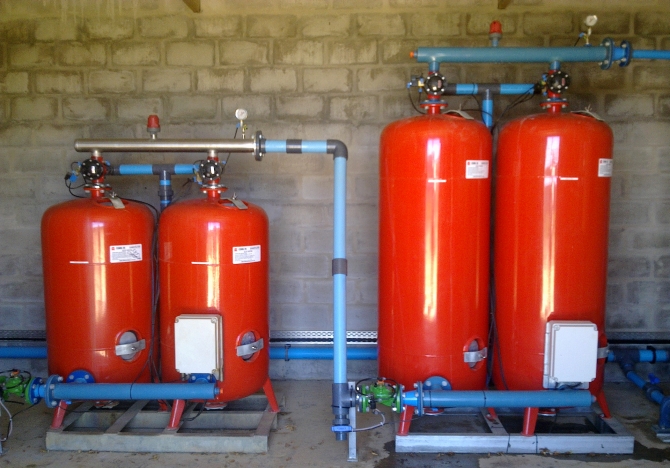
Multimedia and Activated Carbon Filters