

Perdeberg winery is located outside Wellington in the Western Cape. it is one of the largest wineries in South Africa.
The original Effluent Treatment Plant (ETP) at Perdeberg Winery comprised the following elements:
- An inlet works with a channel auger screen for the removal of larger solids and two settling chambers for the removal of grit.
- A balancing dam to equalise the highly variable effluent flows and organic loads from the cellar.
- A raw effluent feed pump station lifts the effluent from the balancing dam into a contact tank where pH adjustment is achieved through the addition of lime.
- The bulk of the COD is removed by an anaerobic process comprising two stages; acid fermentation followed by methane formation. This is achieved in two anaerobic ponds through which effluent is recycled at a continuous rate to ensure proper mixing and pH control.
- An aerobic pond serves to polish the effluent from the anaerobic ponds from where it is discharged to an irrigation dam.
Unfortunately the plant had never operated satisfactorily due to a number of shortcomings in its design. A2V were approached for a proposal to identify and rectify these shortcomings. We determined that there were two main problems with the plant:
1. Solids Removal
The existing channel screen and settling basins were ineffective. This led to an accumulation of non-biodegradable solids in the balancing dam and anaerobic ponds which has in turn led to:
- Reduced equalisation capacity
- Blocking and tripping problems with the Raw Feed Pumps
- A reduction of treatment capacity in the anaerobic ponds where active biomass was largely been replaced by solids
- Blocking problems in the interconnecting pipework
2. Recycle Rate
The recycle rate measured on site was found to be inadequate which had the following negative effects on the process:
- Poor mixing in the active zone of the anaerobic ponds, leading to poor treatment.
- Due to lower flow rates in the pipe work, there was a propensity for solids to settle out which lead to added to the problem of numerous pipe blockages.
- The pH and alkalinity control was not as effective, which led to poorer performance and ultimately acidification (failure) of the anaerobic biomass.
A preliminary check on the plant hydraulics suggested that the current plant design was limiting the recycle rate that could be achieved.
A2V proposed a cost effective solution , making use of existing infrastructure as far as possible:
1. The existing auger screen was retained and refurbished with a larger aperture basket.
2. The equalisation pond was converted to a settling pond through the addition of a floating decanter.

Installation of a floating decanter into the equalisation dam
3. The recycle pumps were refurbished with larger impellers and motors to achieve a higher recycle rate.
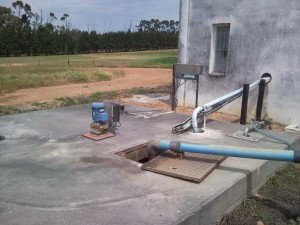
Lime mixing tank for pH adjustment
4. Bottlenecks in the interconnecting pipework were removed to facilitate higher recycle rates.
5. Scum baffles were fitted to the anaerobic ponds to prevent debris from blocking pipework.
The solution was implemented in a phased approach starting in January 2012. Immediate improvements in plant performance and operability were achieved after implementation.